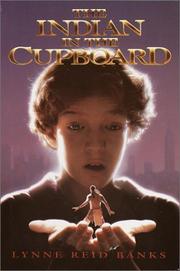
 What child hasn’t imagined the wonderful guardian he could be to a tiny being, such as a grasshopper or toad borrowed from the yard? Young Omri in the Indian in the Cupboard, Lynne Reid Banks, (1980, 184 pages) gets that chance, in this case with a tiny toy Indian that comes to life. However, the creature is a real person, and the responsibility turns out to be heavier than expected.
For his birthday, Omri is given a small plastic figure of an Indian that he doesn’t think is anything special at first. He also receives an old cupboard and a key that can lock it. He discovers that whatever toy figure he puts in the cabinet comes to life while remaining the same size, then can be made inert again by being locked in the cabinet a second time. He brings to life an Indian, named Little Bear. He later animates a cowboy called Boone, and briefly, a medic.
The author could have penned this book without a time travel angle, and as the plot is written time travel does not loom as large as in most time travel tales. In the story, the Indian, cowboy and medic were real people who find themselves suddenly in Omri’s time without knowing how they got there. The trio share with Omri just a few details of their earlier lives. Little Bear reports he is Iroquois and fought with the English against the French and Algonquin Indians. This struggle was part of an ongoing battle for land in the westward expansion days of the US. This indicates Little Bear was from the 1700’s. The cowboy was from 1889. The medic doctored soldiers during WW I. We don’t get to learn a lot about the past from this book, although the story describes Omri as being newly interested in history and eagerly reading a book about Iroquois life from the library.
This story is close to perfect for so many reasons. I found the description of the coming to life of the small figures and their exploration of Omri’s bedroom and backyard almost unbearably vivid. Because of the details the author includes, I could see it right before me. Omri tries to provide Little Bear and the cowboy with everything they need. He brings a spoonful of beans and eggs to Little Bear and Boone which is a huge bowlful of food to them. When in the backyard Little Bear rides a tiny horse that Omri brought to life, we can see that the pebbles are like boulders to Little Bear, and the weeds like trees.
This is such a suspenseful book. The vulnerability of Little Bear and the cowboy are obvious because of their size. Reading the story, you hold your breath hoping that rough kids or animals don’t get at them. Not only are the pair in danger because of their small size, when they first meet they are prone to fighting each other. Omri is a good protector though, and even finds a way to help Boone and Little Bear, initially enemies, make friends.
Omri’s character is likeable. He is at first bursting with excitement and can hardly keep from bragging to his friends about the magic he can make in his bedroom. He eventually shares his secret with his best friend Patrick whom he entrusts with Little Bear and the cowboy for a time. But Patrick is not a good guardian and puts the pair in great danger. Omri realizes that for the tiny beings’ safety they have to be protected from Patrick and kept secret from everyone else. He summons the will to do that. Omri respects Little Bear and the cowboy and tries to protect their dignity. He resists the temptation to exploit his great power as a giant over them.
The courage the miniature people display as they try to figure out the new world they have found themselves in is touching. Little Bear and Boone have distinct voices and are very funny. Although tiny, their personalities loom large.
Maybe I especially loved this story because some of my favorite playthings as a kid were small plastic figures.The coming to life of the plastic Indian might seem especially striking to people over a certain age who can picture the type of toy described. I imagine most kids don’t play with toy Indians anymore. Other than a few stowaways in an old Lincoln Logs set leftover from my husband’s childhood, my kids have never seen plastic Indians, and certainly have never played with them. Members of the American Indian Library Association would probably say it is a good thing children don’t play with toy Indians anymore. After all, we don’t play with tiny Italians, right?
The American Indian Library Association did not love this book. In one of their publications, “I” is not for Indian” they wrote,
The Indian in the Cupboard and its sequels are much-loved books by librarians and their patrons. But for Indian people, these are some of the worst perpetrators of the most base stereotypes. The miniature toy Indian (Indians portrayed as objects or things) is described as an Iroquois warrior, but is dressed as a movie western version of a generic plains Indian “chief”, complete with eagle feather headdress. The warrior is described in the most stereotypical terms and speaks in subhuman grunts and partial sentences. He is manipulated by a more powerful white child, fostering the image of the simple and naive Indian whose contact with the white man can only benefit him and his people.
AILA has a valid point and sadly, this stereotyping mars an otherwise perfect book. At the end of “I is not for Indian,” they note 13 thought-provoking “What to look for”questions to ask about a book to see if it might be demeaning to Indians. Despite the stereotyping in The Indian in the Cupboard, I think kids should read it because of all its merits. It would be best if adults could also talk with them about the true diversity of American Indian culture.
George Woods in his book review titled Books: Best for Children of 1981 called The Indian in the Cupboard “the best novel of the year.” He also noted that although set in Great Britain it has, “few intrusive Briticisms”, a detail which always brings a smile to my face. I love that Common Sense Media said of the movie based on the book, “Teens may enjoy it but feign indifference.” I am glad I am way past adolescence so I can gush unabashedly about this book.
 timetraveltimestwo.com