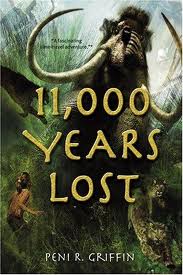
 I really, really wish I could get in a time machine and travel back to observe some Clovis people of Texas like the ones written about in 11,000 Years Lost by Peni R. Griffin, (2004, 307 pages.) Because the past they lived in was so distant, there is so little we know about them. I have often dreamed of being able to hear what early human’s language sounded like. After reading this richly imagined book, I have another question: what did their songs sound like?
The story is about eleven-year old Esther, who becomes fascinated with an archeological dig that is going on in her hometown. She is allowed to help out at the site, bringing drinks, and doing small jobs for the workers. The kind leader of the dig, Dr. Durham, explains as much as she can to Esther about the artifacts they are finding, and what is known about Clovis society.
One day Esther attempts to help out Dr. Durham by trying to find the remains of a Clovis campfire. Esther wanders in the woods, imagining this past society she has heard so much about, and suddenly she is seeing the land differently. There are two translucent layers– the familiar one, and superimposed upon it an unfamiliar one with different trees. Esther walks through a couple pine trees that weren’t there a moment ago, and then the familiar world disappears completely, and she is way, way back in time, 11,000 years. It’s a magical moment.
I love this image of a portal to time travel: two layers that gradually resolve into one. This is one of the best treatments of the transition from the present to journeying back in time that I have read in a time travel story. When I was about eleven years old my family took some double exposures with our Kodak Instamatic camera. These accidents turned out to be pure serendipity–two images coming together in a wholly unexpected way. That’s sort of how I picture these shimmering layers Griffin writes about.
Esther has to survive in the tribe of about twenty people she meets there until she can find her way back home. Like the other book reviewed in this blog by Peni R. Griffin, Switching Well, this book is rich in period details. I want to give a shout-out here to Ms. Griffin for taking the time to do the research that makes this kind of detail possible. Thank you for your hours upon hours of work.
Ms. Griffin writes in her Author’s Note at the end of this book:
What am I good at? What am I good for? Who do I love? Who loves me? How should I behave? These are the questions that all people have to answer for themselves, in every age, under every circumstance.
She does a great job of answering them for the characters in this story. Ms. Griffin’s tale has rich character development and is full of emotion–my kind of story. The book was about how the people survived, mostly focused on their quest for food, but also on the emotional relationships between the characters. It was a long book, the psychological stuff was kind of complex, and while I think older readers will love it, I think it might actually go over the head of younger middle grade readers. But I now count it among my top ten all time favorite time travel stories.
 timetraveltimestwo.com